
By Meg Burns // July 19th, 2023
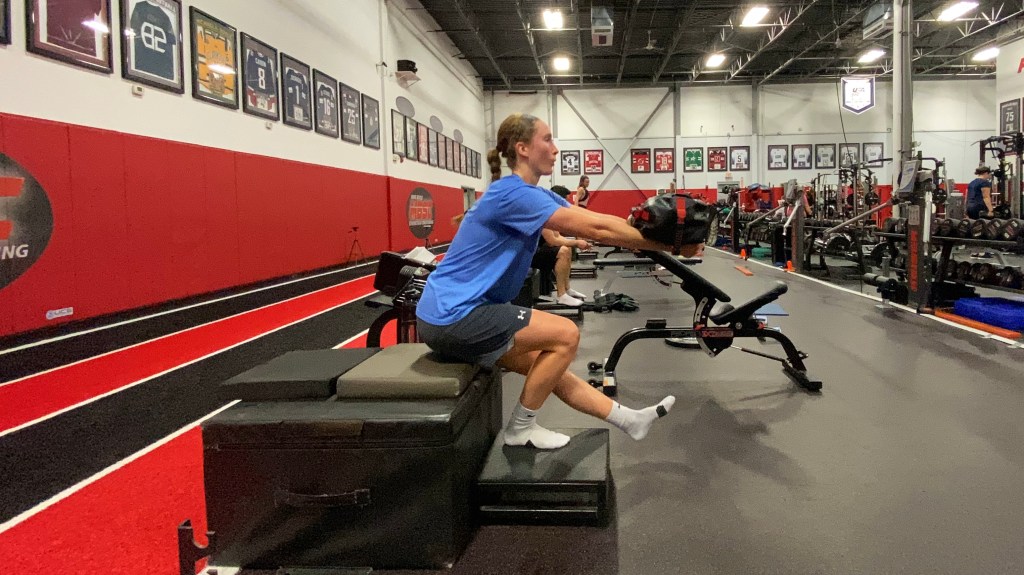
Until a few months ago, the idea of ditching the conventional back squat and making the switch to unilateral, lower-body training was completely foreign to me. That was until I read Mike Boyle’s book, New Functional Training for Sport, and began my internship at MBSC. My initial reaction as I read was, “it just makes sense.” Sports are played primarily on one leg. Why would we train primarily on two?
Athletes of all sports can benefit greatly from training unilaterally. The reality is that all sports are far more similar than we might think. Almost all sports require a combination of skills such as sprinting, jumping, changing direction, moving laterally, and throwing. Again, because these movements are often performed on one leg, there must be an emphasis in training proper mechanics, increasing strength, and improving power unilaterally.
In my learning from Mike’s book and my time interning at MBSC, I have found three primary reasons why unilateral training benefits athletes and should be incorporated into training programs: (1) It’s safe, (2) effective in improving strength and performance, and (3) reduces the risk of performance-related injuries.
Safe Method of Training
When it comes to training for all populations it’s important for a coach to follow the Risk-to-Reward ratio. Ideally, we find exercises that are low risk, but offer a high reward. In other words, we want to program lifts that are safe to perform but produce desirable performance outcomes. Most back issues in athletes result from performing heavy squats. Loading an individual under a heavy back squat or with a heavy barbell deadlift can cause a great deal of unwanted stress on the lower back and lead to injury. Unilateral exercises like the split squat, one-leg squat, and single-leg deadlift are great examples of low risk, high reward exercises. These lifts offer a significant challenge with less external load, therefore lowering the chance of injury during training.
Effectively Improves Strength and Performance
Believe it or not, you are stronger with one leg, than you are on two. Performing a double-body-weight bilateral squat is equivalent to performing a single-leg squat with 50% of your body weight in external load:
2 x BW Squat = 0.5 x BW One-Leg Squat
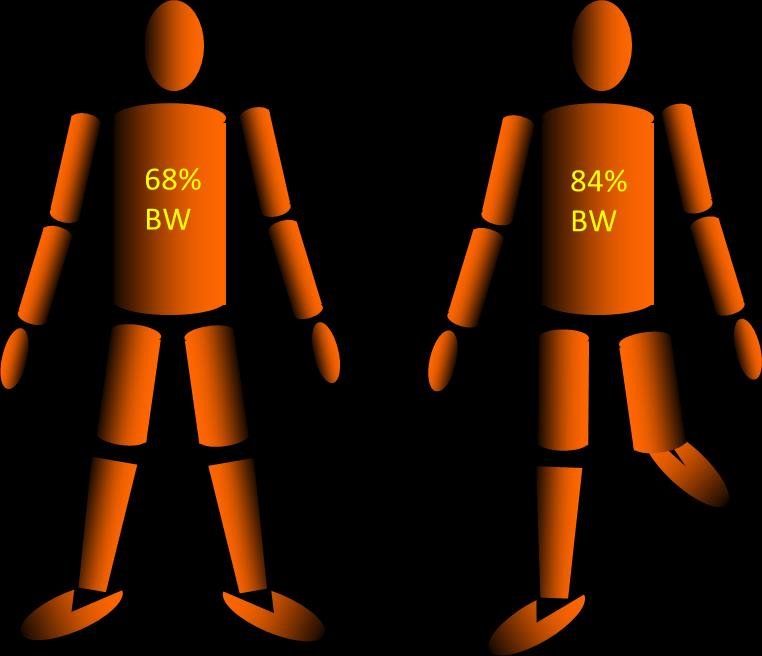
A 1955 study done on airplane pilots (Dempster, 1955) helps to demonstrate this phenomenon. It found that when seated, 68% of the pilot’s body weight is in the plane seat, meaning that the combined body weight above the hips (torse, arms, head) accounts for 68% of the total body weight while the remaining is divided into 16% on the right leg and 16% on the left leg. Therefore, someone who is performing a one-leg squat is moving 84% of their body weight. For example, if you have someone who weighs 220 pounds, their body weight one-leg squat would be 184.8 pounds (0.84 x 220).
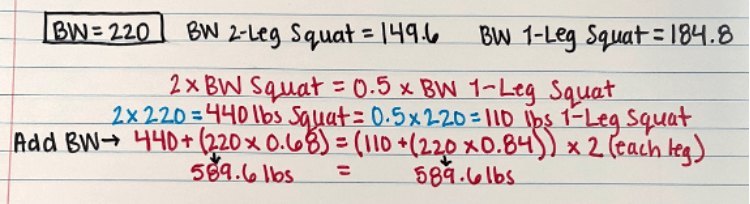
Using these findings on weight distribution, a researcher named Alex Natera, in a study comparing the load ratio in single leg and double leg movements, was able to demonstrate that single-leg movements are more challenging than we think. If you take the same individual from our example above that weighs 220 pounds, if he can do a one-leg squat with an external load of 110 pounds, or half his body weight, that is equivalent to him squatting 440 pounds, or double his body weight, according to the equation. But how do we know this to be true? Well, when performing lower body exercises, body weight becomes a part of the load. So, if you add body weight into the equation, you see that these loads are, in fact, equal. The individual pushes a load of 589.6 total pounds in both cases, as seen below:
You can be tremendously strong on one leg! With unilateral training, we can improve lower body strength and power without loading a 400-pound barbell on the spine and putting athletes at risk for injury during training. In addition to gains in strength, there have been observed benefits in power production when comparing a single-leg vertical jump to a double-leg vertical jump. The sum of two vertical jumps, one on each leg, is typically greater than the height of a single, double-leg vertical jump, exemplifying the bilateral deficit.
It’s common for people to believe that if you remove one leg from the exercise, you are only half as strong as you are with two. This is clearly not true. Again, this all goes back to the idea of Risk-to-Reward. Unilateral, lower-body exercises are a great example of low risk, high reward movements that will effectively make your athletes stronger, more powerful, and more resilient without the added risk of injury.
Reduces the Risk of Performance-Related Injuries
Incorporating single-leg movements into a strength training program is an effective method of injury reduction. Performing single-leg exercises requires balance, thereby engaging the gluteus medius, adductors, and quadratus lumborum to act as stabilizers to support the movements. Muscles responsible for stabilization are essential in sport. They work to resist movement in joints that could lead to injury. Single-leg variations not only improve the strength of the target tissues but also work to increase the strength of stabilizer muscles that are otherwise unused in conventional double-leg exercises. Introducing an athlete to instability helps to improve balance and proprioception, skills that are both necessary for performance because the athlete must demonstrate stability in their sport. Performing a single-leg, unilateral hip dominant exercise may be the key to preventing hamstring injuries. The posterior chain is often neglected in strength programs, but these exercises target that muscle group directly.
Training unilaterally has proven to be a functional method for sports and will always be a part of my athlete programs as a coach. If you want to train safely, improve strength and performance, and lower the risk of performance-related injuries, consider incorporating more unilateral training into your workouts.
 Meg Burns